Mapa Mental Ingles Simple Present

Learning how to build a mapa mental ingles simple present is one of the fastest ways to organize basic actions, daily routines, and universal truths in English.
What is a mind map in English and why use it for the simple present
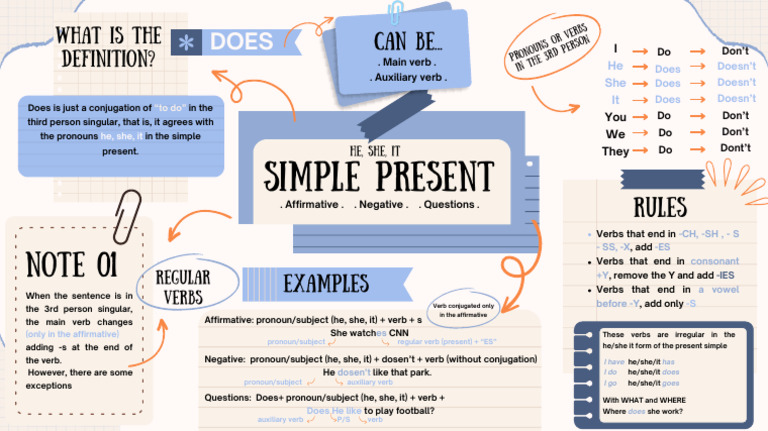
A mind map is a visual tool that starts with a central idea and branches out into related words, phrases, and examples. When you focus on the simple present, a mapa mental ingles simple present helps you see connections between verbs, time markers, subjects, and everyday situations at a glance. Instead of memorizing long lists, you create a colorful network that shows how "I eat," "She works," and "They play" fit into a bigger pattern. This structure is especially useful for learners who want a clear, intuitive overview of how the simple present works in real life.
By drawing a mapa mental ingles simple present, you turn grammar into a picture that is easy to review before speaking or writing. You can place frequency adverbs like always, usually, and never on one branch, time expressions like every day and on Mondays on another, and sentence patterns on a third branch. This visual organization supports memory, helps you notice missing parts, and makes it easier to explain the simple present to classmates or students. Over time, your personal map becomes a quick reference that reduces hesitation and boosts confidence.

The core structure of the simple present in a mind map
At the center of your mapa mental ingles simple present, write the phrase "Simple Present" and surround it with the three key pillars: form, meaning, and use. Under form, add branches for positive statements, negative forms, and questions, including examples like "He walks," "She does not walk," and "Do they walk?" Under meaning, note general truths, habits, and routines, linking each meaning to clear symbols or color codes. Under use, list time markers such as often, sometimes, on Mondays, and in the morning, so that your map highlights when and why this tense appears.
To keep your mapa mental ingles simple present practical, use short verbs, pronouns, and adverb phrases that you actually need. Create separate branches for affirmative sentences, negative sentences, and interrogative forms, and add tiny icons for frequency, place, and time. You can also add a branch for spelling rules, such as adding -s or -es in the third person singular, and another branch for common mistakes to avoid. This way, your map becomes both a study tool and a checklist you can follow when you speak or write.
How to build your own mapa mental ingles simple present step by step
Start with a blank page or a digital canvas, place "Simple Present" in the middle, and draw the first branches for subjects like I, you, we, they and he, she, it. From each subject, extend lines to verbs, time expressions, and frequency adverbs, grouping related items so that your mapa mental ingles simple present stays clear and uncluttered. Use different colors for verbs, time words, and sentence types, and add small examples directly on the branches to make the map more memorable.

As you practice, update your mapa mental ingles simple present with new situations, such as daily routines, job descriptions, or universal facts, so that it grows into a personalized grammar notebook. Review the map regularly, cover the branches and try to recreate them from memory, then check your work and correct mistakes. This active recall strengthens your ability to form sentences quickly and to recognize the simple present in listening and reading tasks. Over time, your map becomes a living document that reflects your progress and evolving understanding of the tense.
Practical examples and common patterns to include
Add concrete examples to each branch of your mapa mental ingles simple present, such as "I walk to school," "She walks to the office," and "They walk in the park" under the verb walk. Include time expressions like always, usually, often, sometimes, rarely, and never, and link them to the correct positions in a sentence. You can also add fixed routines like "I have breakfast at 7:30" and universal truths like "The sun rises in the east" to show how the simple present covers both habitual actions and facts.
To capture negative and question forms in your mapa mental ingles simple present, create dedicated branches with clear formulas and short samples. For negatives, note "subject + do not/does not + verb," with examples such as "I do not walk" and "She does not walk." For questions, write "Do/Does + subject + verb," and add examples like "Do you walk?" and "Does he walk?" By organizing these patterns visually, you reduce confusion and make it easier to retrieve the correct structure when you need it.

Tips for using your mind map in real learning situations
Use your mapa mental ingles simple present during speaking practice by choosing a branch, such as daily routines, and describing your own day aloud using as many examples as possible. In writing sessions, follow the branches to build sentences, check subject verb agreement, and make sure time markers are in the right place. If you study with a partner, explain parts of your map to each other, asking and answering simple present questions based on the visual structure.
Keep your mapa mental ingles simple present concise, clear, and easy to update so that you actually return to it. Review it regularly, add new verbs and contexts, and remove items that no longer challenge you. When you connect your map to real tasks, such as writing emails, describing habits, or talking about schedules, it becomes more than a grammar exercise and turns into a practical tool for everyday English.
Conclusion
Building a mapa mental ingles simple present gives you a clear, visual summary of how the tense works, making it easier to remember forms, meanings, and uses. With a well organized map, you can quickly review key patterns, practice speaking and writing, and gain confidence in everyday English. As you continue to expand and revise your map, you will find that the simple present becomes more intuitive, accurate, and natural in your communication.
Simple Present ❗ O Tempo Verbal mais Utilizado no Inglês❗ | Teacher Elza
No vídeo de hoje falaremos sobre o Presente Simples! O tempo verbal mais utilizado no inglês. Vou te mostrar quando e como o ...
